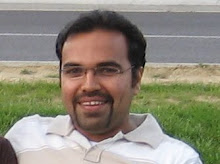


Here's an interesting piece of trivia i chanced upon - the tamilian movie-star politicians, MGR, Jayalalithaa (extra 'a' owing to numerology), Vijaykanth and Rajinikanth are all outsiders. The tamil superstar, MGR is a mallu. Jayalalithaa is a kannadiga, Vijaykanth is an andhrite and as everybody knows rajini is a marathi. Add to this the fact that MDMK chief vaiko is an andhrite naidu. Puzzles me.
Thursday, May 29, 2008


Thursday, May 8, 2008
Thesis Abstract
After three years of research (yeah, right!), i've finally begun to write my thesis. So here's the abstract of it:
Title: Towards Load Balanced De-congested Multi Robotic Agent Traffic Control by Coordinated Control at Intersections
Abstract: Network mediated robot navigation has become popular in recent years from different viewpoints. Firstly the network acts as a computing medium thereby reducing the computational payload on-board the robot. In a manner akin to swarm robotics where each of the individual entity has limited intelligence but the group in itself behaves as a sufficiently intelligent system, the network allows the robots to be possessed with minimal decision making capabilities but the network plus the robot behaves as a system of enhanced intelligence. Secondly the network provides for fault tolerance capabilities for if the on-board sensors fail or misbehave the robotic agent can look up to the network for information about the environment. Thirdly the network supplements the computational capacity of the robot. Efficiently designed sensor fusion algorithms can agglomerate intelligence gathered through on-board as well as off board resources to come up with robust decisions. In this work, we developed algorithms for multi robotic traffic control in a world mediated by a network. While single robot navigation mediated by a network is well studied there has been little in the area of multi robotic navigation.
In this work, we present a methodology for coordination of multiple robotic agents moving from one location to another in an environment embedded with a network of agents, placed at strategic locations such as intersections. These intersection agents communicate with robotic agents and also with each other to route robots in a way as to minimize the traffic congestion, thus, resulting in the continuous flow of robots. A robot's path to its destination is computed by the network in terms of the next waypoints to reach. The intersection agents are capable of identifying robots in their proximity based on signal strength. An intersection agent controls the flow of agent traffic around it with the help of the data it collects from the messages received from the robots and other surrounding intersection agents.
The congestion of traffic is minimized using a two layered hierarchical strategy. The objective at the primary level, operating at the intersection, is to reduce congestion at the intersection by reducing the time delay of robots crossing them. The flow of traffic is coordinated by assigning priorities to pathways based on the robot density and its rate of change. In this method the robotic agent hailing from the pathway having the highest agent density and lowest rate of change is allotted the highest priority and the paths of agents with lower priority are attuned to accommodate the paths of the robot with higher priority. The intersection agent allows passage for the robot, that has requested space-time allocation at the intersection, till the point of no conflict in the path of the vehicle through the intersection. The secondary layer maintains coordination between intersection agents and routes traffic such that delay is reduced through effective traffic load balancing. The load balancing of robots over multiple intersections is achieved through coordination between intersection agents by communication of robot densities in different pathways. Routing of a robot from its initial position to its destination in the best available path is done. Individually each robot's path in the environment is distributedly computed by the network as a sequence of waypoints to the goal, each successive waypoint one hop less than the previous. Here, the waypoints are the intersections. Intersection agents coordinate to propagate the robot traffic density information to their neighbors so that at each intersection, the agent guides a robot towards the next waypoint which promises minimum time delay.
In the area of multi-agent traffic control, work has been done based on a first come first served like policy. Our method of coordination at intersections is achieved by considering density and rate of change of density along the incoming pathways to an intersection. Extensive comparisons show the performance gain of the current method over existing ones. Theoretical analysis apart from simulation show the advantages of load balanced traffic flow over uncoordinated allotment of robotic agents to pathways - uniform traffic load is maintained at all intersections and no particular intersection is overwhelmed with robots while others are free of them. Transferring the burden of coordination to the network releases more computational power for the robots to engage in critical assistive activities.
Title: Towards Load Balanced De-congested Multi Robotic Agent Traffic Control by Coordinated Control at Intersections
Abstract: Network mediated robot navigation has become popular in recent years from different viewpoints. Firstly the network acts as a computing medium thereby reducing the computational payload on-board the robot. In a manner akin to swarm robotics where each of the individual entity has limited intelligence but the group in itself behaves as a sufficiently intelligent system, the network allows the robots to be possessed with minimal decision making capabilities but the network plus the robot behaves as a system of enhanced intelligence. Secondly the network provides for fault tolerance capabilities for if the on-board sensors fail or misbehave the robotic agent can look up to the network for information about the environment. Thirdly the network supplements the computational capacity of the robot. Efficiently designed sensor fusion algorithms can agglomerate intelligence gathered through on-board as well as off board resources to come up with robust decisions. In this work, we developed algorithms for multi robotic traffic control in a world mediated by a network. While single robot navigation mediated by a network is well studied there has been little in the area of multi robotic navigation.
In this work, we present a methodology for coordination of multiple robotic agents moving from one location to another in an environment embedded with a network of agents, placed at strategic locations such as intersections. These intersection agents communicate with robotic agents and also with each other to route robots in a way as to minimize the traffic congestion, thus, resulting in the continuous flow of robots. A robot's path to its destination is computed by the network in terms of the next waypoints to reach. The intersection agents are capable of identifying robots in their proximity based on signal strength. An intersection agent controls the flow of agent traffic around it with the help of the data it collects from the messages received from the robots and other surrounding intersection agents.
The congestion of traffic is minimized using a two layered hierarchical strategy. The objective at the primary level, operating at the intersection, is to reduce congestion at the intersection by reducing the time delay of robots crossing them. The flow of traffic is coordinated by assigning priorities to pathways based on the robot density and its rate of change. In this method the robotic agent hailing from the pathway having the highest agent density and lowest rate of change is allotted the highest priority and the paths of agents with lower priority are attuned to accommodate the paths of the robot with higher priority. The intersection agent allows passage for the robot, that has requested space-time allocation at the intersection, till the point of no conflict in the path of the vehicle through the intersection. The secondary layer maintains coordination between intersection agents and routes traffic such that delay is reduced through effective traffic load balancing. The load balancing of robots over multiple intersections is achieved through coordination between intersection agents by communication of robot densities in different pathways. Routing of a robot from its initial position to its destination in the best available path is done. Individually each robot's path in the environment is distributedly computed by the network as a sequence of waypoints to the goal, each successive waypoint one hop less than the previous. Here, the waypoints are the intersections. Intersection agents coordinate to propagate the robot traffic density information to their neighbors so that at each intersection, the agent guides a robot towards the next waypoint which promises minimum time delay.
In the area of multi-agent traffic control, work has been done based on a first come first served like policy. Our method of coordination at intersections is achieved by considering density and rate of change of density along the incoming pathways to an intersection. Extensive comparisons show the performance gain of the current method over existing ones. Theoretical analysis apart from simulation show the advantages of load balanced traffic flow over uncoordinated allotment of robotic agents to pathways - uniform traffic load is maintained at all intersections and no particular intersection is overwhelmed with robots while others are free of them. Transferring the burden of coordination to the network releases more computational power for the robots to engage in critical assistive activities.
Saturday, May 3, 2008
Dreams - 2.
This post is a part of my Dreams Series ....
1. Three of my schollmates with whom i regularily hang out on saturdays are in a park, with lush green grass and gigantic coniferous trees. I zoom into the park on a motorcycle disturbing the conversation my friends were having. I keep going at max speed in the park and go over a small hill on the grass land, the impact of which hurls me into space - I see the dream as a third person - and i am way above all the trees. After a moment of unparalleled thrill, i come crashing down to earth and i woke up.
2. A schoolmate of mine whom i haven't called in many days rings me up and asks for an explanation. She was angry and sounded highly disappointed.
1. Three of my schollmates with whom i regularily hang out on saturdays are in a park, with lush green grass and gigantic coniferous trees. I zoom into the park on a motorcycle disturbing the conversation my friends were having. I keep going at max speed in the park and go over a small hill on the grass land, the impact of which hurls me into space - I see the dream as a third person - and i am way above all the trees. After a moment of unparalleled thrill, i come crashing down to earth and i woke up.
2. A schoolmate of mine whom i haven't called in many days rings me up and asks for an explanation. She was angry and sounded highly disappointed.
Monday, April 28, 2008
Dreams - 1.
Obviously one must hold oneself responsible for the evil impulses of one's dreams. In what other way can one deal with them? Unless the content of the dream rightly understood is inspired by alien spirits, it is part of my own being. - Sigmund Freud
Thanks to the book 'The Interpretation of Murder' my interest in psychoanalysis and freudian theories got renewed. The wannabe freud in me wants to interpret my own dreams and would be happy if anybody else interprets them for me. So from today onwards i would describe my (printable) dreams in my blog space. Here are few of the dreams i dreamt in the past couple of days -
Thanks to the book 'The Interpretation of Murder' my interest in psychoanalysis and freudian theories got renewed. The wannabe freud in me wants to interpret my own dreams and would be happy if anybody else interprets them for me. So from today onwards i would describe my (printable) dreams in my blog space. Here are few of the dreams i dreamt in the past couple of days -
- A giant board based tile game with numbers written on the tiles. I wasn't particularly keen on solving the puzzle but was just thinking there should be many 2's on the tiles.
- I hear a non-telugu speaking labmate of mine speaking fluent telugu and i wonder what personal stuff i might have talked in front of him assuming he doesn't understand my language.
Thursday, March 20, 2008
'Hair' raising indeed!

It came as an unpleasant surprise for me to see the headlines 'Darrell Hair reinstated by ICC' yesterday in the papers and all the time-pass websites. I absolutely hate him.
He first hit the limelight during the Srilankan tour of Australia, Circa 1995, when he kept on no-balling Murali for what he felt was chucking. I vaguely remember watching the match at my uncle's place-only place to watch cable TV those days-finding the entire no-balling fiasco pretty amusing. I was a Srilanka-hater those days for reasons i don't remember and i was enjoying srilankans being at the receiving end but my uncle was at his abusing best directing his tirades at Hair. Those days i cudn't understand all the sub-continental criticism of the Umpire-in-question, but now i do. He's the epitome of Australian arrogance, one among the countless firangis who believe they are superior and judicious compared to the so-called browns hailing from the lands of chaos. Hair's bio would be full of controversies, right from his first test, when he a gave string of poor lbw decisions against Indians which ultimately lead to their defeat by 38 runs, till his last match as an umpire in which he alleged the Pakistanis of ball tempering. I am sure Hair would have seen no reason in all his criticism, in his view he is just upholding the laws of cricket. Another good example of this firangi behavior is the incident that occurred in the Sydney test of the recently concluded India tour of Australia - the umpire Mark Benson consulted Ricky Ponting instead of the leg umpire to decide whether the ball from ganguly's blade was caught properly or not. It was an outrageous moment, something which seconds my earlier hypothesis. The enormous clout that BCCI enjoys in ICC these days made sure Mark Benson wouldn't go unrepentive , but it was a crime he shouldn't have committed in the first place. I have no doubt in believing the reason for Hair's reinstatement is to appease ECB and CA who are getting increasingly insecure about their position in ICC with the emergence of the ebullient BCCI.
Tuesday, February 19, 2008
Doomsday.
Trying to distract yourself from something sweet and lovely is difficult. While i was trying to figure out how it could be done i came up with an idea to list all the ways man-kind(woman-kind as well) could end! So here's what my demented brain could think of -
- A Nuclear Holocaust: Pakistan, which in Chomsky's words is the paradigm example of a failed state, as we all know is a nuclear power. The current political unrest in pakistan is a matter of great concern to all the countries of the world as the extremists and fundamentalists threaten to take over the reigns. No matter how much Gen. Mush claims that he has the situation under control the fact remains that there is a possibility of terrorists usurping power and getting hold of Pakistan's huge nuclear arsenal. Potential targets are USA, India, Israel, Europe. Enough to end man-kind i believe!
- An Asteroid Impact: An asteroid impact on Earth could have a devastating effect. This theory, made popular by hollywood movies, is as realistic as any other in my list. Earth, moving at a speed of sixty-six thousand miles an hour, goes through an orbit which is criss-crossed my millions of asteroids every year. The number of asteroids which are big enough to completely obliterate human existence runs into thousands but that's not the scariest part - most(read it as almost all) of these asteroids are undetectable. So forget sending a team of drillers to the asteroid and try nuke it, we won't even know until somebody yells 'look, the sun is falling!'. An asteroid of the size of a truck(there are millions of them) could take out an entire city! The chain of events that would unfold after an impact from an asteroid of a football ground's size is unfathomable. It would be wrong to imagine it would only destroy a small region on the planet's surface, the potential aftermath could be breathtaking to hear; first, the asteroid would compress the atmospheric air beneath it and as a result would burn everything in its path even before it touches them!. Second, It would burn/kill/destroy everything that's within a few hundred miles from the site of impact. Third, a flash of blindening light followed by complete darkness. Fourth, my favourite, everything that is within a thousand miles would be flattened out and completely destroyed. This is just the immediate effect of the impact, what follows afterwards is another story. Earthquakes, volcanic eruptions, tsunamis, we are gonna have them all! Half the planet would be on fire and the dust, soot and smoke would block sun for many years disrupting the ecological balance and all the natural cycles essential for life. Mass exodus would lead to utter chaos. Scary!
- Global Warming: Most boring! We have heard enough of global warming in the last one year that it has become so banal to talk about it. But all this hype is not without a reason, global warming sits right in front of us looking straight into our face. It is the only possible catastrophy in my list that could be prevented through collective responsibility. The possible effects of global warming, as wikipedia states, are extreme weather, increased evaporation, destabilization of local climates, glacier retreat, rising sea levels, temperature rise, acidification, shutdown of thermohaline circulation, forest fires and not to mention the drastic effects on world economy. Quite a lot of them, each of which could cause serious damage to the human race. Those who are willing to to do their bit in fighting this monster can visit al gore's site and find out what you can do.
- An Epidemic: Influenza, cholera, Spanish flu, HIV, Bird flu; History books are full of stories telling about different diseases that plagued humans and caused millions of death at various periods of time. A new virus surfaces each decade causing misery to thousands. Billions of dollars are spent each year on influenza research only to find the virus has mutated and the vaccines have no effect. There is every possibility of a deadly virus cropping up from somewhere and wiping out the entire living population.
- Super Volcanoes & Plate Tectonics: Earth has a history of super volcanic eruptions which have been linked to the mass extinction of certain species. A series of volcanic eruptions around 65 million years ago in India is speculated to be the cause of the most famous paleontology mystery - the disappearance of dinosaurs from the face of Earth. Intense geological activity caused by the friction between tectonic plates could trigger volcanoes and earthquakes leading to mass destruction.
- Exhaustion of Natural Resources: All the natural resources of the world would get exhausted in the coming few decades with a few a exceptions like the arab world which can boast of huge deposits. Barrel prices would increase making the arabs rich until one day when a fuel-starved country decides to attack them. I would like to think this could set-off of a chain of destructive events, it's my f***in imagination after all.
- Theories from Fiction: I would list some of my favorite theories from books and movies - blood thirsty zombies, created by a biological experiment gone horribly wrong or by alien radiation, alien invasion, devil has a whim to end the world, godzilla rising from the seas, a mad scientist resurrects dinosaurs, robots stop listening to humans and last but not the least, my favourite, a black hole created accidentally by an atom smasher!
Subscribe to:
Posts (Atom)